
Many Faces Of Problem Decomposition
One Weird Trick Used Across Industries

I love thinking tools and frameworks, and encountered many of them by working in design, finance, consulting, IT, and non-profits. I got excited when I saw many of them fit a similar pattern.
Consider these frameworks:
Ishikawa Diagrams & Issue trees in consulting,
Opportunity Solution Trees in product management,
Fault Tree Analysis in risk management,
Attack Trees in cybersecurity,
Theory of Change in activism and charity work.
For me, these frameworks are all doing the same thing, or at least they overlap in a big way.
They’re decomposing outcomes into sub-components.
They’re decomposing complex problems into branching structures where each big question splits into smaller questions, each goal factors into sub-goals, each task into sub-tasks. It’s recursive problem-breaking, and it’s the secret architecture behind how experts think across wildly different domains.
Common ingredients
The power of these “thinking tools” comes from three structural properties:
1. The root is an outcome of the “leaves”
You start with your problem: either a bad thing you want to prevent, or a good thing you want to achieve. Then you list everything that contributes to or enables the root. Each node contributes to its parent, creating clear cause & effect relationships.
(Some tools reverse this causality: Decision Trees or Event Trees trace consequences forward from a starting point, but that serves a different purpose.)
2. You aim for completeness without overlap
When properly constructed, branches at each level are mutually exclusive (no double-counting) and aim to be collectively exhaustive (nothing important is missing). This is the MECE principle, and it’s what ensures you’ve actually explored the entire problem space.
3. You can always go deeper
The same decomposition logic applies at every level. Any branch can become a new root for its own sub-branches. You might start an issue tree with “high labor costs” rather than decomposing all of “low profit margin”. Choose the resolution that serves your purpose.
Why it works
Our working memory is limited
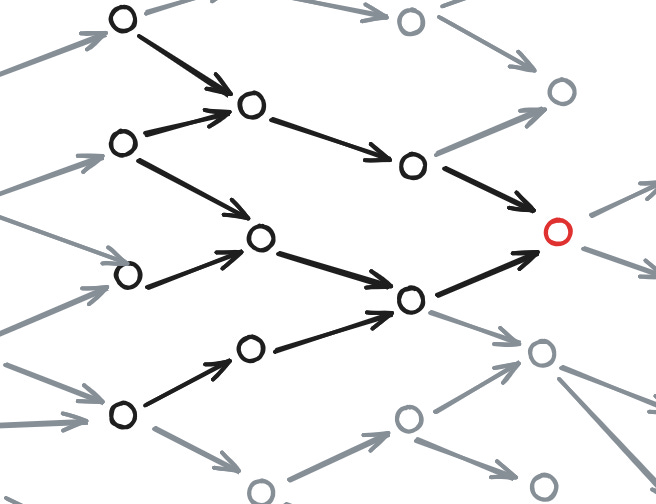
I like to think that these trees are essentially a focused slice of the vast network of all causes and effects. It’s intentionally constrained to what matters right now and structured to be navigable.
Step-by-step beats thinking harder
If missing something important could cost you dearly, or if you’re hunting for non-obvious solutions, systematic decomposition outperforms simply staring at the high level question longer.
We reason better backward from outcomes
I once got a premortem interview question: “Imagine you take our offer and regret it after six months. What happened?” It was far easier to generate reasons working backward from that hypothetical regret than to answer “what could go wrong?”
Jeroen Kraaijenbrink suggests this is because premortems exploit our hindsight bias:we explain past events better than we imagine future ones. By treating a future failure as already happened, we get “prospective hindsight.” One bias (hindsight) helps beat another (the planning fallacy).
When in doubt, decompose
Next time you face a complex problem, try drawing a tree. Put the outcome you care about at the root, then ask: what are all the distinct things that could cause or enable this? Repeat at each branch until you’ve reached nodes that you can act on.
You’ll likely find that the structure does much of the thinking for you: surfacing gaps, revealing non-obvious paths, and making the problem tractable. The experts in many fields figured this out. I’m curious where else can we reapply this pattern.